Showing posts with label Film. Show all posts

Saturday

HOWARD GREENBERG GALLERY: Vivian Maier

Vivian Maier: Self Portrait Exhibition
 Photograph (c) Dina Regine
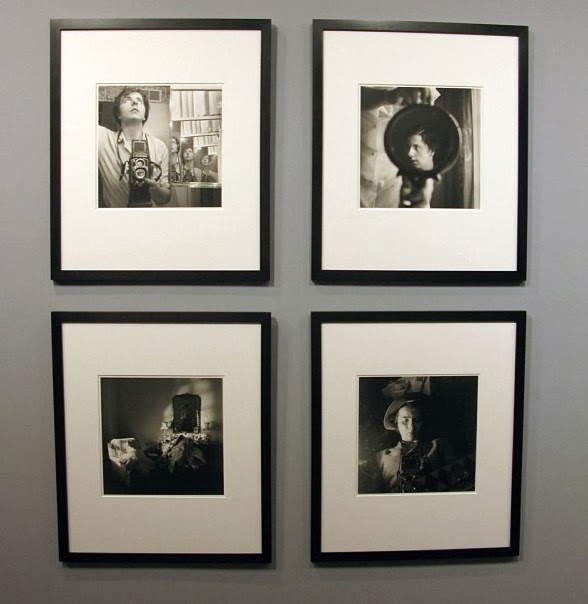
Vivian Maier: Self Portraits

 
Glass case with Vivian Maier's Rollei and small color prints

Curator Frances Vignola and Filmmaker Collector John Maloof

Also showing, Vivian Maier's unpublished work

An exhibition of self-portraits by recently discovered street photographer Vivian Maier made from 1950 – 1976 are on view at Howard Greenberg Gallery to January 4, 2014. The exhibition coincides with the publication of the book Vivian Maier: Self-Portraits (powerHouse Books, November 2013) that surveys Maier’s self-portraits, many of which are being shown and published for the first time.

The story of Vivian Maier has practically become a photography legend:  Born in New York City in 1926, she spent much of her youth in France. Returning to the U.S. in 1951, she worked as a nanny in Chicago and New York for 40 years. Reclusive and eccentric, she took pictures all the time, yet never showed them to anyone. From the 1950s to the 1990s, with a Rolleiflex dangling from her neck, she made over 100,000 images, primarily of people and cityscapes.

Maier’s massive body of work, which could have been destined for obscurity, was housed in a storage locker in Chicago for many years. Unbeknownst to her caretakers (three of the grown children she had looked after), the contents of her storage locker had been dispersed due to non-payment. Her negatives were discovered by Chicago-based realtor and historian John Maloof at an auction house in Chicago in 2007. Maloof pieced together the identity of the mysterious photographer, but Vivian Maier died in 2009, before Maloof was able to speak with her. In the years that followed, Maloof has brought her work to the attention of the art world and the general public; and since 2010, nearly 20 exhibitions of photographs by Vivian Maier have been mounted in the U.S. and Europe. Numerous critics have written that her work will be remembered as some of the best 20th-century street photography.

Vivian Maier: Self-Portrait at Howard Greenberg Gallery is the first exhibition to explore the photographer’s numerous self-portraits and the first U.S. gallery exhibition of her color work.  

Vivian Maier: Self-Portrait
Exhibition: Nov 7 – January 4, 2014

Howard Greenberg Gallery
41 East 57th Street
New York, NY
Vivian Maier: Self-Portraits
Photographs by Vivian Maier, Edited by John Maloof
Essay by Elizabeth Avedon. Published by powerHouse Books

(Text courtesy Howard Greenberg Gallery)

CHRISTOPH KLAUKE | DOUBLE PORTRAITS

 Double Portraits  
Photograph (c) Christoph Klauke

Double Portraits  
Photograph (c) Christoph Klauke

Double Portraits  
Photograph (c) Christoph Klauke

Double Portraits  
Photograph (c) Christoph Klauke

German born Photographer Christoph Klauke, based in London, received his Bachelor of Arts degree from Brooks Institute of Photography in California. Over the years Klauke has gone on to work for many publications, including The New York Times Magazine, French Vogue and Vanity Fair, as well as solo exhibitions in London, Paris, Tokyo, Basel and Lugano.

His first book, The 28 Faces of Corinne Dolle, was published in 2011. I spoke with him recently about the upcoming launch in London of his second book, Double Portraits.
 +  +  +

EA: How long have you been working on your series, Double Portraits?

CK: I started Double Portraits with the intention of making a portrait photo book in early 2000. I had my own photo studio then, in an up-and-coming area of London called Spitalfields. After relocating to New York in the summer of 2001, I continued with the portraits in New York until 2004 and finally finished a third chapter on the West Coast in 2005. On returning to  London I thought I would be able to place the project with one of the specialist publishers but it proved impossible. I self-published my first photo book two years ago, as a form of trial run for the "Double Portraits" book.  I would recommend to other photographers to do the same. Although painful at times, it is incredibly rewarding to stay in control of the book production process.

EA: Are these portraits identical?

CK: No, the portraits are similar but not identical. There is a time lag of several seconds between the first exposure, the left photograph and the second exposure, the right photograph. All these portraits were taken with an 8x10" Deardorff camera, which requires using a heavy tripod. The left frame is focused and composed, the second is uncontrolled. The sitter knows that I am taking two pictures and is attempting to sit still. Since the depth of field in this close up setting is so shallow, there is inevitably some movement or at least a different expression in the second photograph. Combined together, the viewer's eye scans for differences and sometimes feels or imagines the moment in between.

EA: How did you arrive at this idea?

CK: Back in Spitalfields, in 1999, I was asked to exhibit in a small space, a former tailor's shop called "Made to Measure" in a Georgian house in Princelet Street.  I did a series of sittings with a local beauty and neighbor, and the first double portraits evolved. The images had to be printed large scale since the work could only be viewed from the street through the shop front window. Today, I am much happier working with small prints, closer to life size. 

EA: How large are the actual prints?

CK: The image size is 8 1/2 x 11" on 9 x12" Agfa paper, so just a minimal enlargement from the 8 x 10" size of the camera negative. The hand prints were made by Brian Dowling in London, close to the time of the sittings. Our intention was to produce a master set of reproduction prints for this book. Other than this set, I have a couple of spare prints of each image and that's it. We had no idea at the time of printing that the paper would disappear soon after. Agfa went bust and Kodak, which made the second most suitable paper stock, also stopped making the paper. It's worth mentioning that the photographs are reproduced 8x10" in size in "Double Portraits"; this is a homage to the 8x10" negative format.

EA: Who was involved with the making of this book?

CK: Stephen Male did the edit and sequencing of "Double Portraits", so when I met with Leon Krempel, I had a dummy with blind text in hand. It was suggested that I approach him with a view to writing the introduction because Krempel had curated and put together a very interesting exhibition and book called "Marlene Dumas: Tronies," where he contrasted historical paintings by the Dutch Masters with contemporary paintings by Marlene Dumas. Tronies are small, isolated paintings of heads. While a rigorous art historian interested in portraiture, Krempel was able to convey what the photographs feel like, as opposed to what they look like.

EA: The book has beautiful design details. Can you tell me a little about the printing, paper and binding?

CK: Lena Mahr is responsible for many of these details. She finished the book design based on the initial design direction by Stephen Male with great diligence. The book was printed by Optimal, one of the top printers in Europe. The paper we used is 115g/m2 Phoenix Motion by Xantur. In Germany the binding we used is called "Japanese binding", but I believe in English it is either known as pouch binding or French binding. Another term for the binding is Japanese fore-edge fold. Besides the obvious advantage of printing only on one side of the paper and having no 'show through', the pages lie almost perfectly flat when opened and don't close on themselves. I have to give the printer credit for this suggestion. It made a big difference for this project.

EA: Your book launch will be September 4th (at Claire de Rouen Books) in London. Any other future plans for this series?

CK: The "Double Portraits" book is really the finished work. There are only 750 books printed and all are numbered.  I would like to produce a sequel, which would involve spending a year or so in Africa, Asia and India, but this would require external funding. And who knows if Kodak survives. One day soon there may not be any film left to take these kinds of photographs.


ChristophKlauke.com

"The first portrait of each pair results from a carefully-established relationship between photographer and sitter. The second shot is taken a moment after the first, capturing the consequences, in the sitter, of becoming a ‘subject’. Sometimes these second portraits show us what León Krempel calls ‘sundered egos'. All of them describe the passing of time and, as such, allude to the way in which portraiture aspires to posterity."
  
  
Double Portraits. Photographs Christoph Klauke

A Limited Edition Hardcover. 156 pages, 56 photographs
First Edition, 750 numbered copies
Contact: Eudora Pascall: 44 (0) 7900 568 745
doubleportraits@gmail.com

DoublePortraits.com